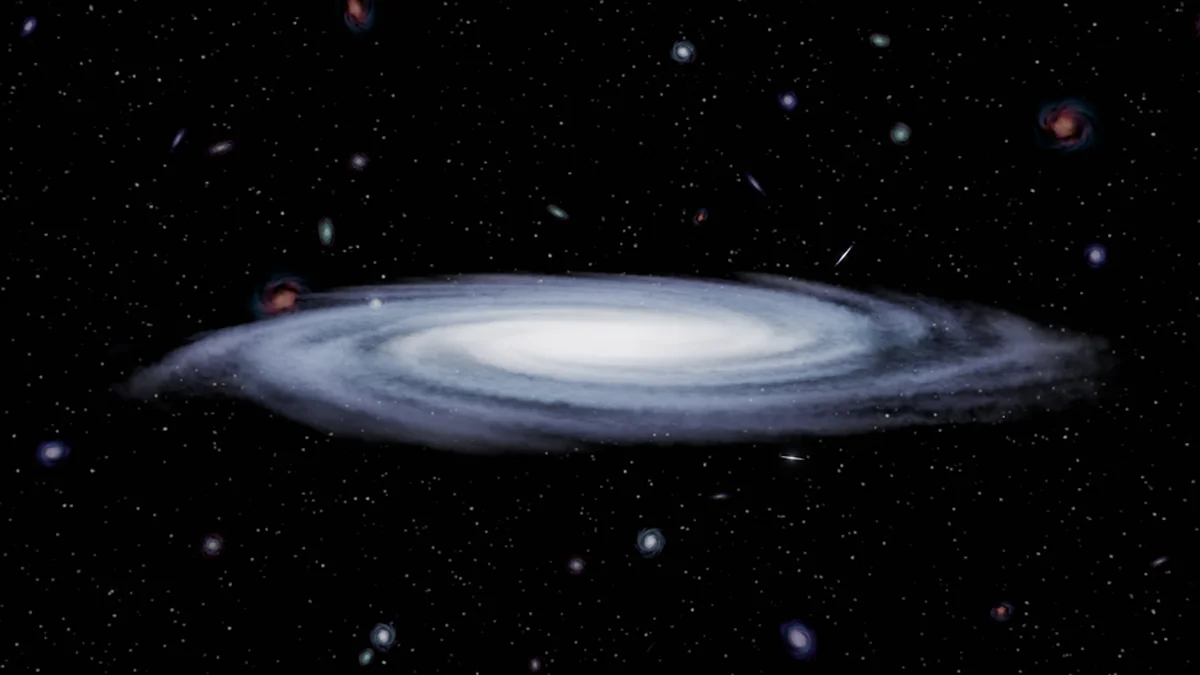
Astrophysicists have presented a new study analyzing the light curve of the transient event AT2024tvd, revealing unusual details about its origin. Typically, stellar disruptions of this nature are observed near the core of a galaxy, associated with a supermassive black hole residing at the galactic center. However, AT2024tvd deviated from this pattern, as the star was disrupted approximately 800 parsecs away from the massive nucleus of its host galaxy, which possesses an estimated mass of 100 billion solar masses.
The research team’s analysis suggests that the event was caused by a wandering supermassive black hole. The authors propose that this mobile black hole may be the remnant material from a smaller galaxy that underwent disruption. To interpret the complex data, the scientists analyzed the light emitted after the initial outburst had faded, utilizing X-ray spectral measurements alongside ultraviolet and visible light photometric data.
They applied the relativistic accretion disk model to this dataset. Through this modeling process, the study determined that the mass of the disruptive black hole is approximately one million solar masses. This finding suggests a significant deviation from expected models of stellar interactions within a large galaxy.
The evidence points toward an independent, wandering supermassive object rather than an interaction confined to the primary galactic center. The findings offer new insights into the dynamics of supermassive black holes and the mechanisms of stellar disruption across vast interstellar distances.
Topics: #galaxy #supermassive #black